

 Facebook
 X
X Pinterest
 Email
Email Text/SMS
 Random
 Subscribe


Answer
The Roman Catholic Church views itself as the one legitimate heir to New Testament Christianity. It also teaches that the pope is the successor to Peter, who it believes was the first bishop of Rome. While these claims are historically questionable, there is no doubt that the Christian church at Rome dates to the first century.
The apostle Paul wrote his letter to the Romans about AD 55 and addressed a church body that existed prior to his first visit there. However, he made no mention of Peter, even though he greeted others by name (Romans 16:1–16). Despite repeated government persecution, a vibrant Christian community existed in Rome after the apostles died. Those early Roman Christians were just like their brethren in other parts of the world—faithful followers of Jesus Christ.
Life in the Empire changed drastically when the Roman Emperor Constantine announced his conversion to Christianity in AD 312. Constantine’s decisions didn’t create the Church instantly, but they set things in motion that led to its development. He issued the Edict of Milan in 313, which granted freedom of worship throughout the empire. When disagreements over Christian beliefs arose, Constantine convened a major meeting of church leaders—the Council of Nicaea in AD 325—even though he was not a church official and had no formal religious authority.
By the time of Constantine’s death, Christianity had become the favored religion of the Roman Empire, though it was not yet officially established as the state religion. The term Roman Catholic was coined by Emperor Theodosius on February 27, 380, in the Theodosian Code. In that document, he refers to those who hold to the “religion which was delivered to the Romans by the divine Apostle Peter” as “Roman Catholic Christians” and gives them the official sanction of the empire.
The fall of the Roman Empire and the rise of the Catholic Church are really two branches of the same story, as the power was transferred from one entity to the other. From the time of Constantine until the fall of the Roman Empire in 476, the emperors of Rome claimed a certain amount of authority within the church, even though it was disputed by many church leaders. During those formative years, there were many disputes over authority, structure, and doctrine.
The emperors sought to increase their authority by granting privileges to various bishops, resulting in disputes about primacy within the churches. At the same time, some bishops sought to increase their authority and prestige by accusing others of false doctrine and by seeking state support for their positions. Some of these disputes led to behavior that both Catholics and non-Catholics today would consider abusive. For example, some who lived in major cities tended to exalt themselves above their contemporaries in rural areas.
The third century saw the rise of an ecclesiastical hierarchy patterned after the Roman government. The bishop of a city ruled the presbyters, or priests, of the local congregations, controlling the ministry of the churches. The Bishop of Rome began to establish himself as the supreme authority. Though some historians present these details as the history of “the church,” many church leaders in those days didn’t acknowledge any ecclesiastical hierarchy. Most churches in the first four centuries derived their authority and doctrine from the Bible and traced their lineage directly back to the apostles, not to the church of Rome.
In the New Testament, the terms elder, pastor, and bishop are used interchangeably for the spiritual leaders of any church (see 1 Peter 5:1–3 where the Greek root words are translated “elders,” “feed,” and “oversight”). By the time Gregory became pope in 590 AD, the empire was in shambles, and he assumed imperial powers along with his ecclesiastical authority. From that time on, the church and state were fully intertwined as the Holy Roman Empire, with the pope exercising authority over kings and emperors.
What are the teachings of the Roman Catholic Church that distinguish it from other Christian churches? Whole books have been written on this subject, but a sampling of the doctrines will be outlined here.
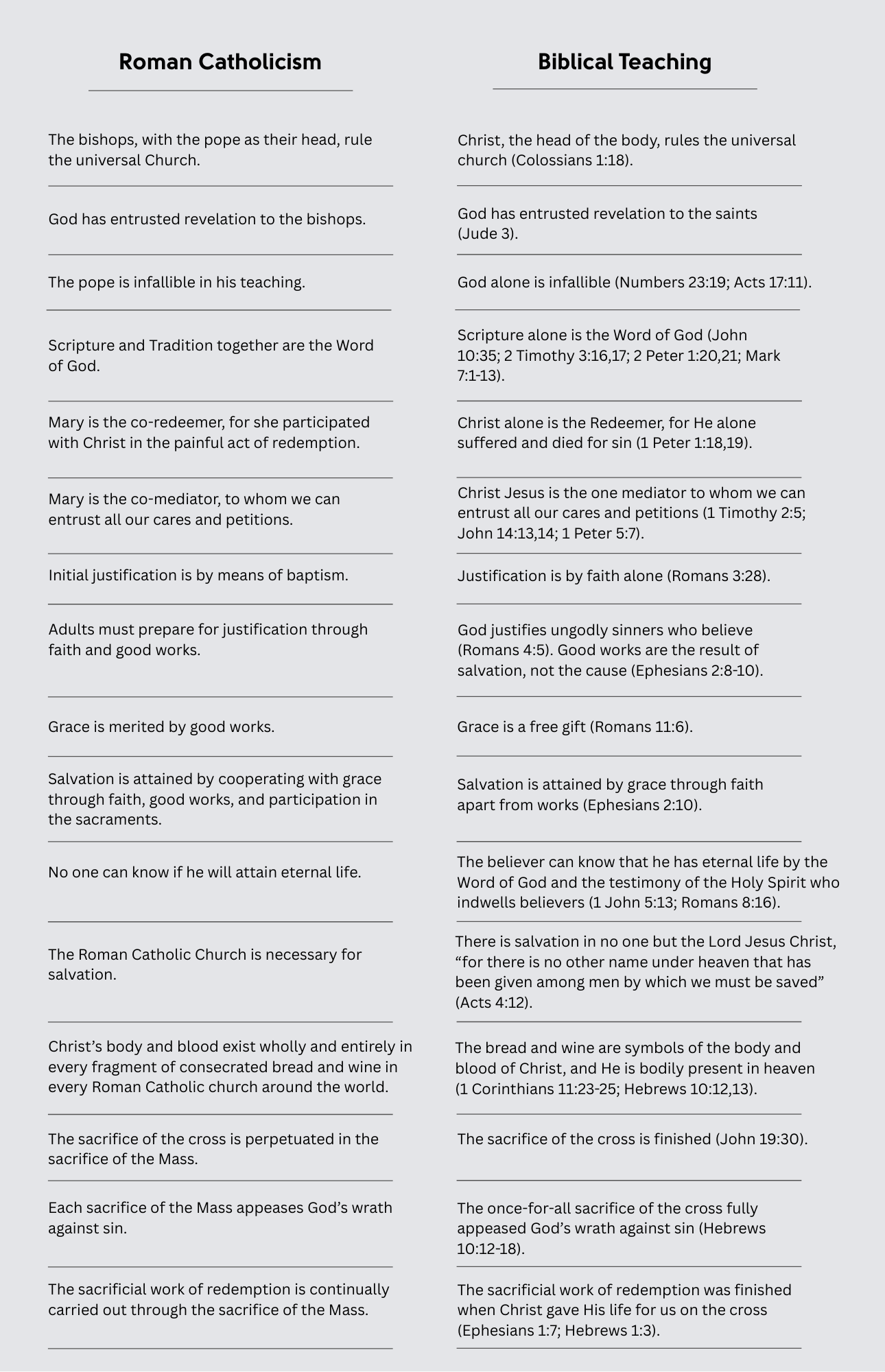
These doctrines don’t date back all the way to Constantine, except in seed form. Most were adopted over many years as various popes issued decrees. In many cases, the doctrines don’t have a biblical basis.
Many Catholics are unaware of the differences between the Church’s teaching and the Bible. The Church has always valued Scripture, but personal Bible study was less common in the past. We are grateful that it is more encouraged today.
